
Tagged: San Diego
San Diego’s Biggest Investment Advisor Firms
The table that follows is derived from the latest SEC data:
| Name | City | AUM | Clients | |
|---|---|---|---|---|
| 1 | Brandes Investment Partners | San Diego | $25,945,405,178 | 19,800 |
| 2 | Torreycove Capital Partners | San Diego | $18,287,962,533 | 11-25 |
| 3 | Guided Choice Asset Management | San Diego | $12,317,410,631 | 500,000 |
| 4 | Stepstone Group | La Jolla | $11,926,414,601 | 100 |
| 5 | Gurtin Fixed Income Management | Solana Beach | $9,929,753,485 | 500 |
| 6 | Chandler Asset Management | San Diego | $8,893,810,490 | 800 |
| 7 | LM Capital Group | San Diego | $5,215,906,609 | 26-100 |
| 8 | First Allied Advisory Services | San Diego | $4,864,088,841 | 25,800 |
| 9 | Clarivest Asset Management | San Diego | $4,150,278,731 | 11-25 |
| 10 | Globeflex Capital | San Diego | $3,611,000,000 | 26-100 |
| 11 | Dowling & Yahnke | San Diego | $3,047,962,290 | 1,000 |
| 12 | Aletgris Advisors | La Jolla | $2,105,402,681 | 26-100 |
| 13 | Rice Hall James & Associates | San Diego | $1,955,115,330 | 300 |
| 14 | Nicholas Investment Partners | Rancho Santa Fe | $1,876,535,379 | 26-100 |
| 15 | American Assets Investment Management | San Diego | $1,661,745,223 | 26-100 |
| 16 | Independent Financial Group | San Diego | $1,647,108,373 | 5,700 |
| 17 | Cuso Financial Services | San Diego | $1,564,559,871 | 6,000 |
| 18 | EAM Investors | Cardiff | $1,266,828,504 | 26-100 |
| 19 | LM Advisors | San Diego | $1,256,305,636 | 600 |
| 20 | Pure Financial Advisors | San Diego | $1,196,742,924 | 1,400 |
| 21 | Dunham & Associates Investment Counsel | San Diego | $1,191,835,520 | 3,900 |
| 22 | Wall Street Associates | La Jolla | $1,075,551,757 | 11-25 |
| 23 | Cardiff Park Advisors | Carlsbad | $1,034,925,745 | 325 |
| 24 | IPG Investment Advisors | San Diego | $1,013,080,208 | 700 |
There are some interesting little stories in here.
Torreycove Capital, founded in 2011, manages $18 billion for fewer than 25 clients, mostly pension and profit sharing plans. Torreycove was named in June as private equity consultant for the $79.2 billion New Jersey Pension Fund.
Brandes has seen its assets under management plummet since 2007, when it had $111 billion under management. According to Pensions & Investments magazine, Brandes’ two largest strategies — international equity and global equity — have been hit hard in recent years. In 2008, Brandes’ AUM declined more than 50% to $52.9 billion.
Stepstone may be the most interesting of them all. StepStone, founded by Monte Brem and Thomas Keck, has grown into a self-described”global private markets firm.” It oversees $75 billion of private capital allocations in addition to its $11.9 billion under management. Stepstone serves as private equity advisor for the states of Connecticut and Wisconsin.
Last year, Stepstone leased the entire 17th floor at the Lipstick Building, the site where Bernie Madoff ran his $65 billion Ponzi scheme.
Mark Cuban files brief supporting … Ray Lucia?

What was I thinking?
Update: A federal appeals court denied Ray Lucia’s appeal to have his lifetime ban overturned in August 2016.
Mark Cuban, the outspoken Dallas Mavericks owner, is a regular on Shark Tank, a show where he’s regularly pitched by entrepreneurs seeking to expand their businesses.
Cuban and the other investors say “I’m in” or “I’m out” depending on whether they like the pitch or not.
Cuban is obviously a savvy investor, but he’s an explosive guy. He’s known in the sports world for his outbursts at NBA officials and referees that have cost him more than $1 million in fines.
Today, I learned that Cuban has filed a friend of the court brief on behalf of Ray Lucia, a former San Diego investment adviser who was permanently banned from trading by federal securities regulators. This legal brief is the courtroom equivalent of an angry outburst at NBA official.
Cuban filed his brief this month in Lucia’s appellate lawsuit against the U.S. Securities and Exchange Commission before the D.C. Circuit Court of Appeals. Lucia argued that his lifetime ban should be thrown out since his case was heard by an administrative law judge, instead of an appointed officer, as required by the U.S. Constitution.
His brief, filed Feb. 8, states, “As a first-hand witness to and victim of SEC overreach, Mr. Cuban has an interest in supporting petitioners’ appeal in this case, and in particular demonstrating that both statutory language and legislative history clearly show that Congress specifically intended that SEC hearings only be held before constitutional officers.”
Seems like weak stuff to me, but Mark Cuban is a vindictive fellow and he has an axe to grind.
The SEC accused Cuban of insider trading when he sold his stake in a Canadian Internet company to avoid a $750,000 loss. Cuban maintained his innocence, and was acquitted by a federal jury in Texas three years ago.
Cuban goes on to state, “When the laws are applied inconsistently or the process by which they are enforced is rigged to favor the government, capital formation is impeded because market participants do not have clear rules for understanding their investment risks.”
This is the point where I say “I’m out.” Ray Lucia wasn’t some bold entrepreneur chasing the next big thing. He was making millions fleecing retirees out of their nest eggs.
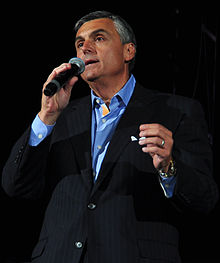
Ray Lucia addressing the crown at Sean Hannity’s Freedom Concert in 2010.
I started writing critically about Lucia in 2010 after his attorney threatened to sue me for $300,00 . I figured that if someone would bother with a bozo like me something must be seriously wrong. Turns out, I was right.
Back then, Lucia was at the height of his power. He had thousands of accounts and $300 million in assets under management. In the 12 months leading up to January 31, 2010, his family of companies reported $14.1 million in gross income, according to court records.
Lucia made money mainly by collecting commissions on those who fell for his “Buckets of Money” strategy. He pitched retirees at flashy seminars, often with the help of his buddy, actor Ben Stein.
Elderly clients were convinced to invest in non-traded real estate investment trusts (REITs) that locked away their money for years. That’s not a great position for an elderly person who needs liquidity, but when REITs are generating $8.7 milllion in gross commissions for Lucia’s companies in 2010, you might overlook such details.
Lucia assured his clients they could retire in comfort because he had backtested his “Buckets of Money” strategy and it was based on “science, not art.” The SEC called his bluff and today, Lucia says he is nearly bankrupt.
Someone, however, must be paying for Lucia’s legal team at Gibson, Dunn & Crutcher, one of the country’s top law firms. Is that you Mark?
Introducing Union-Tribune bathroom tissue…
 One year into its new ownership under LA billionaire Tom Gores and his Platinum Equity, The San Diego Union-Tribune preparing to roll out its new re-design Tuesday.
Publisher Ed Moss has promised to do more with less. He’s making good on the latter, although he has yet to deliver on the former.
The paper that lands on your doorstep tomorrow will be a “bit” narrower, according to Publisher Moss, who assures us it will also be “more efficient” — newspaper doublespeak for less wordy.
Newspapers are shrinking across the country to save on the costs of newsprint, which is what they call the actual paper that lines birdcages and can be shaped into funny hats. The print of U.S. newsprint is up to 14 percent this year. That’s still well below what Canadian mills need to make a profit.
How narrow will the U-T get?
The Union-Tribune currently measures about 12 inches, the same width of the Wall Street Journal and other big newspapers.
It’s likely to follow the LA Times, and the North County Times which all shrank in February to 11 inches. Any smaller will invite mockery.
Unlike the LA Times, however, the Union-Tribune will be changing to a (presumably larger) typeface.
We all learned in grade school that shrinking margins and bigger writing is the way to make your paper seem longer than it actually is.
Consultants tell newspaper executives that readers don’t really care about the width of the page and some even like it. In the short run, that may be true. In the long run, it means there’s even less in the newspaper. Which means there’s more of a reason to look elsewhere for news.
But there’s … more. The U-T is promising more emphasis on graphics and photos, which will further crowd out all the refocused news and investigations they are promising us.
That’s the funny thing about doing more with less. The only thing you can do with less is less.
2010 Top San Diego Money Managers
The top San Diego money management firms with more than $1 billion in assets under management based on SEC regulatory filings as of June 12, 2010.
| Firm Name | Location | Assets Under Management |
|---|---|---|
| Brandes Investment Partners, LP | San Diego | $53,111,776,127 |
| Pacific Corporate Group LLC | La Jolla | $19,823,150,992 |
| Guided Choice Asset Management, Inc. | San Diego | $19,238,786,500 |
| PCG Asset Management, LLC | La Jolla | $19,203,420,729 |
| Nicholas-Applegate Capital Management LLC | San Diego | $9,916,244,833 |
| Gurtin Fixed Income Management, LLC | Solana Beach | $6,747,183,972 |
| Relational Investors LLC | San Diego | $6,033,534,431 |
| Chandler Asset Management Inc | San Diego | $5,005,221,338 |
| Globeflex Capital LP | San Diego | $4,182,000,000 |
| LM Capital Group, LLC | San Diego | $4,010,525,407 |
| Clarivest Asset Management LLC | San Diego | $1,800,000,000 |
| First Allied Securities, Inc. | San Diego | $1,654,019,937 |
| Stolper & Co., Inc. | San Diego | $1,574,982,908 |
| Wall Street Associates | La Jolla | $1,528,000,000 |
| Dowling & Yahnke, LLC | San Diego | $1,473,382,112 |
| Denali Advisors, LLC | La Jolla | $1,274,412,604 |
| Rice Hall James & Associates LLC | San Diego | $1,203,218,265 |
| Caywood-Scholl Capital Management LLC | San Diego | $1,094,183,050 |
| Independent Financial Group, LLC | San Diego | $1,043,692,374 |
| Macquarie Funds Management | Carlsbad | $1,005,232,323 |
@ 2010 Seth Hettena
Negative Equity in the San Diego Housing Market
San Diego’s housing market may have much further to fall.
So says a new report from the NY Federal Reserve that calculates how many homeowners will become renters over the next few years.
In San Diego, 16 percent of homeowners will become renters, according to the study
This measure assumes that homeowners who owe more than their homes are worth — i.e. negative equity — are in effect renters.
Since the homeownership gap reflects the extent of negative equity in the housing market, it is also a gauge of the potential downward pressure on the offcial homeownership rate. Assuming that house prices do not appreciate over the next several years, negative equity households will very likely convert to renters when they move out of their current homes because they will be unable to save enough to cover the negative equity, the transaction costs of selling their existing home, and a down payment on another home. As these transitions from owning to renting take place, the homeownership gap will narrow, with the offcial homeownership rate dropping toward the effective rate.
Consider, for example, that the Case-Shiller-based effective homeownership rates for … Detroit, New York City, San Diego, and San Francisco are all under 50 percent. That is, the median household in these areas is in a negative equity position and no longer has strong financial incentives to behave as an owner. While the effects will vary with the distribution of negative equity households across the municipalities within these metro areas, a high share of these households could result in reduced maintenance of the housing stock, an increased risk of housing vacancies, and less stable neighborhoods over time—developments that could have repercussions for local law enforcement. Moreover, the predominance of “non-homeowners” in these metropolitan areas could lead to a decline in citizen participation in local affairs, with a concomitant loss of vigilance over the quality and ef?ciency of public services and institutions.
 Trump / Russia